As leaders we often overlook the time needed to know ourselves, giving our energy to guiding others instead, but this is a missed opportunity. And it's a really poor example to set.
To start with, what is your answer to the question "what is a leader?"
A leader is simply someone that people want to follow.
That's my answer, and it's a quote from my Mum. She says she heard it somewhere, but I googled and couldn't find anyone else to attribute it to.
And I love the simplicity of it, and where it has lead me.
Why am I someone that people want to follow? Why are you?
Knowing yourself as a leader — what you value, what you prioritise, what you're good at, what you're not … this knowledge can be your greatest asset when you need to navigate the unknown or unpredictable.
While I might not have always been as self-aware of my own philosophy and framework as I am now, when I look back, it's been pretty consistently reflected in the way I have approached work — from my days as a PM during the dotcom boom, to running a graduate programme in India, to my time as regional managing director, to my work as CTO. This framework has emerged from how I have learned to take the best of myself, and the best of what I have adopted from others, and apply it to how I lead.
Everyone has their own philosophy (whether they know it or not) that guides their role/s as leaders — here is mine. And please note that one of the things I know about myself is that I am not a graphic designer 🙂
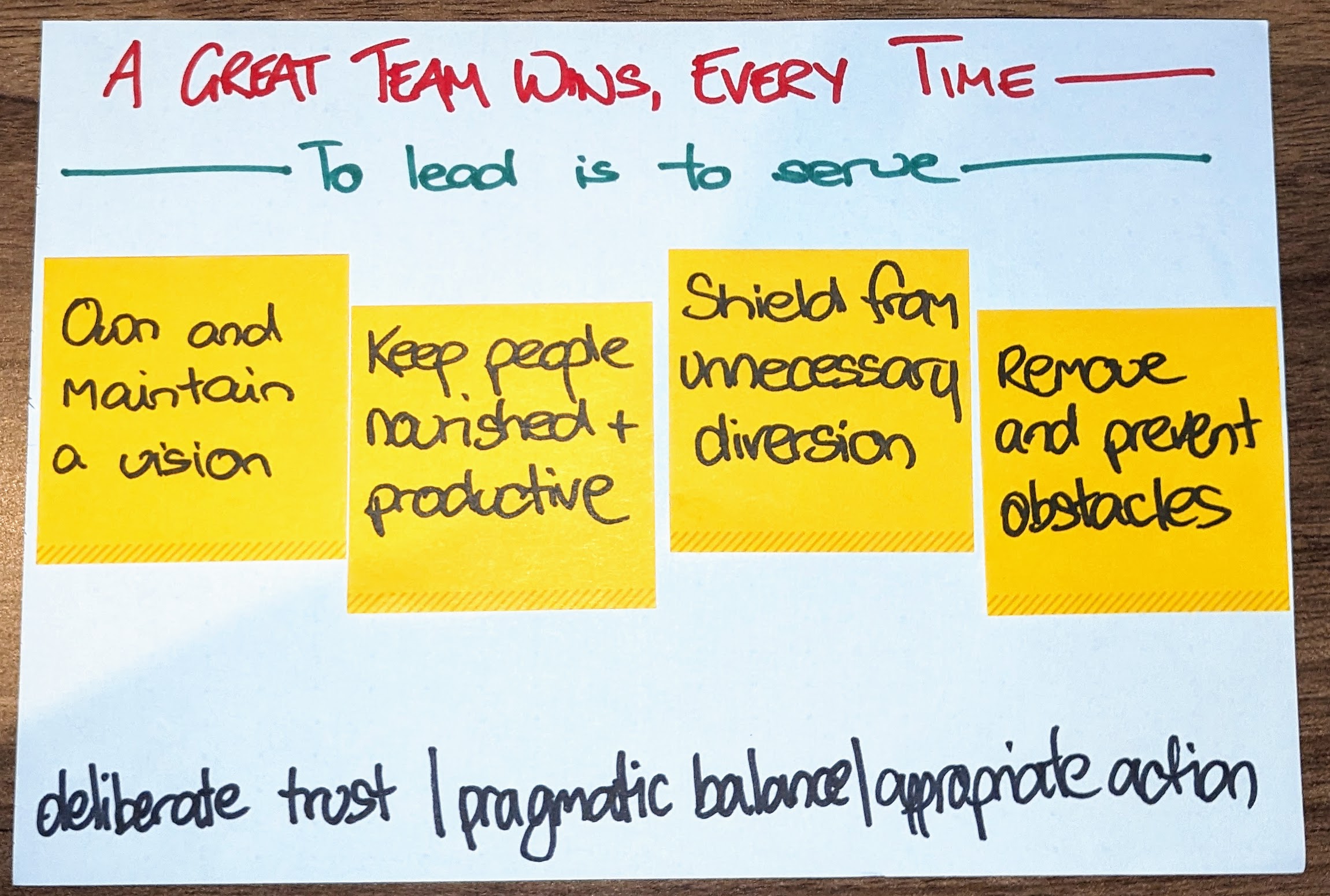
So, first and foremost is the knowledge, that a great team will win, every time, and that my role is primarily one of service. And so it's my job to build and serve a great team.
Servant leadership and the four things — I guess I'd call them core responsibilities — in the middle were probably the first thing I understood about my own leadership style, and I started to articulate them in about 2010.
Almost everything I find myself doing, is in service to one of these four things. And if it's not, I question whether it needs to be done.
And at the bottom is the how — partly how I choose to do it, and partly who I choose to be while leading.
I choose to deliberately trust at the outset. I tell people this and I live it as much as possible — I am human after all. I assume competence and I assume integrity, at least until I see evidence to the contrary.
I choose to share broader perspectives and context as much as possible to provide pragmatic balance to those working in the weeds day to day.
And the big one for me — I choose to ensure appropriate action is taken. My role is often not to take action myself, but to identify decision points and action points and to ensure action is taken.
A few posts where I dive into some of this a little more:
- A Team Can't be Great Without Trust
- Servant leadership and the four things